The Vanishing of Time
A compact appendix insert arguing that time, in several leading physical frameworks, is not fundamental but emergent from correlations, entropy, and information — and that subjectively felt continuity (Bergson’s durée) can be read as the universe’s way of “remembering change.”
Create an HTML insert.
Claim
Time vanishes at the fundamental level in canonical quantum gravity and reappears as a relational and thermodynamic parameter — an index of changing correlations. The felt “flow” corresponds to memory: the system’s retention of ordered differences. If time is emergent from correlations, then memory is not in time; time is in memory.
Three Lines of Argument
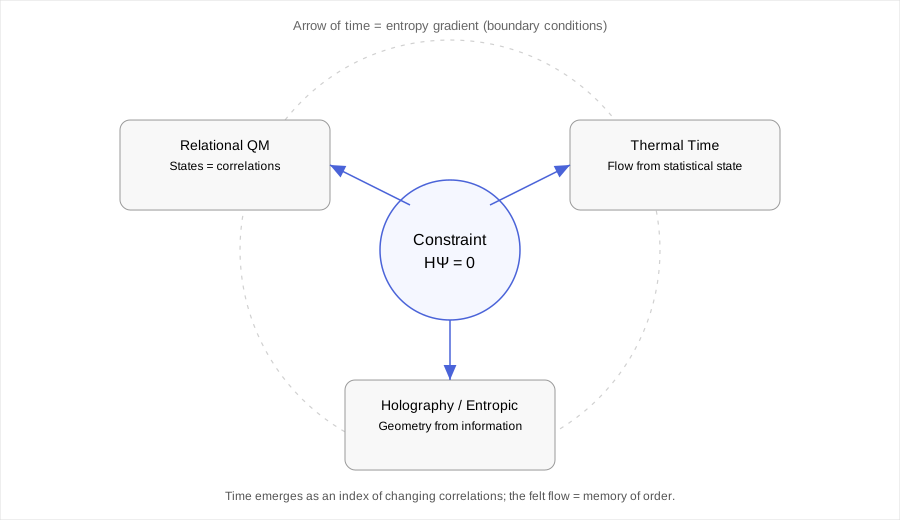
- Canonical Quantum Gravity: In the Wheeler–DeWitt framework the universal wavefunction satisfies
HΨ=0— no external time parameter. This is the “problem of time.” - Relational & Thermal Time: In relational quantum mechanics, states are only defined relative to other systems; Connes–Rovelli’s thermal time hypothesis derives a time flow from a system’s statistical state (Tomita–Takesaki theory).
- Emergent Spacetime: In holographic/entropic approaches, spacetime (and with it, time) emerges from underlying quantum information; gravity appears as an entropic or dual description.
Diagram (describe)
From Timeless Core to Emergent Flow: Center: “Constraint surface HΨ=0” → arrows to three rims: (A) Relational correlations (RQM) → local clocks; (B) Statistical state (Thermal Time) → modular flow; (C) Entanglement structure (AdS–CFT / entropic gravity) → macroscopic spacetime. Outer ring: “Arrow of time = entropy gradient (boundary conditions).”
Citations
| Topic | Source | URL |
|---|---|---|
| Problem of time in quantum gravity | Stanford Encyclopedia of Philosophy: Quantum Gravity | plato.stanford.edu/entries/quantum-gravity/ |
| Relational Quantum Mechanics | Rovelli (1996), Int. J. Theor. Phys. & arXiv | arxiv.org/abs/quant-ph/9609002 |
| Thermal Time Hypothesis | Connes & Rovelli (1994), Class. Quantum Grav. & arXiv | arxiv.org/abs/gr-qc/9406019 |
| Entropic gravity | Verlinde (2011), JHEP & arXiv | arxiv.org/abs/1001.0785 |
| Holography (AdS–CFT) | Maldacena (1997/1999) & arXiv | arxiv.org/abs/hep-th/9711200 |
References
- Weinstein, S., & Rickles, D. (2005/2006). Quantum Gravity. In E. N. Zalta (Ed.), Stanford Encyclopedia of Philosophy. https://plato.stanford.edu/entries/quantum-gravity/
- Rovelli, C. (1996). Relational Quantum Mechanics. International Journal of Theoretical Physics, 35(8), 1637–1678. https://arxiv.org/abs/quant-ph/9609002
- Connes, A., & Rovelli, C. (1994). Von Neumann Algebra Automorphisms and Time–Thermodynamics Relation in General Covariant Quantum Theories. Classical and Quantum Gravity, 11, 2899–2918. https://arxiv.org/abs/gr-qc/9406019
- Verlinde, E. (2011). On the Origin of Gravity and the Laws of Newton. Journal of High Energy Physics, 2011(4), 29. https://arxiv.org/abs/1001.0785
- Maldacena, J. (1999). The Large N Limit of Superconformal Field Theories and Supergravity. Advances in Theoretical and Mathematical Physics, 2, 231–252. https://arxiv.org/abs/hep-th/9711200